Whether you use the internet to work, study, or proceed in touch with loved ones, a modem is the most important device in your network. Without a modem, you won't be able to connect to the internet at all. Only what is a modem, and what does it exercise? Here'due south everything you lot need to know almost what a modem is, if you really demand a modem and a router, and if you should buy your own modem.
What Is a Modem?
A modem is a network device that connects your local area network (LAN) to the wide expanse network (WAN), also known as the internet. Nigh modems are connected via a phone line, coaxial cable, or optical fiber.
What Does a Modem Practise?
A modem "modulates and demodulates" (or converts) the analog betoken from your internet access provider (ISP) and the digital signal from your router, calculator, and other network devices, so you can connect to the internet.
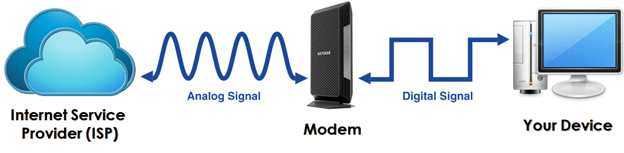
Modems also correct information errors and control the flow and size of information that is sent to and from your network. Your modem will send data dorsum if the information sent past your Isp doesn't match certain values assigned to your devices. It can also tell your continued devices when to transfer data, how much data to send, and how fast data transfers volition exist.
Analog vs DSL vs Cable vs Fiber Optic Modems
There are several types of modems, including analog, Integrated Services Digital Network (ISDN), digital subscriber line (DSL), cable, and fiber optic. While analog, ISDN, and DSL models all use telephone lines, cable modems apply a coaxial cable, and fiber optic modems utilise glass or plastic strands that are about as thin as a human hair.
Analog and ISDN
Analog modems only let one data stream at a time, which means you lot tin can't talk on the phone and surf the web at the aforementioned time. As well, analog modems are very ho-hum and can only achieve speeds upwards to 56 Kbps (kilobits per 2d). To improve on this, ISDN was developed to bear up to iii data streams at the same time. With ISDN, you can get speeds upward to 128 Kbps. These two "punch-up" connections are rarely used today.
DSL
DSL modems even so use phone lines to transmit information, just they work on a different frequency, so y'all can make phone calls while yous are using the cyberspace. With DSL, you lot can get speeds up to 100 Mbps (megabits per second). However, these speeds are usually unachievable, and your connection will be impacted past how far you are physically located from your ISP's nearest station. Typically, DSL connections just reach speeds between 5-l Mbps.
If you want to know more most what a good cyberspace speed is, cheque out our article here.
Cablevision
Cablevision modems are faster and more reliable than DSL. While cable connections won't exist impacted by how far you are from your ISP, your connexion will slow down when there are lots of subscribers using the internet at the same time in your area. Cable can support speeds upwards to 1 Gbps (gigabits per second), however, most users will only get 25-200 Mbps.
Cable and DSL are the almost common types of modems on the market today. While cablevision is faster than DSL, it is also more than expensive, and information technology is not as widely bachelor in rural areas.
Cobweb Optic
While DSL and cablevision both use electric signals to transfer information, fiber optic uses light pulses. That means your connexion won't exist impacted past how far away yous are from your Isp or how many of your neighbors are using the internet at the same time. While nearly ISPs only provide fiber optic plans with speeds up to 1 Gbps, businesses tin can go plans that support speeds up to ten Gbps. However, most users will only get speeds between 50-1,000 Mbps.
Fiber Optic net service is more expensive than cable or DSL, and information technology has very limited availability. According to the FCC'southward latest numbers, merely 40% of the state has access to a fiber optic provider.
Do You lot Need a Modem and a Router?
You will need both a modem and a router if you want to apply WiFi or connect multiple devices. Since most modems only accept one LAN Ethernet port, you can only connect one computer at a time, and a modem won't provide the aforementioned security that a router does.
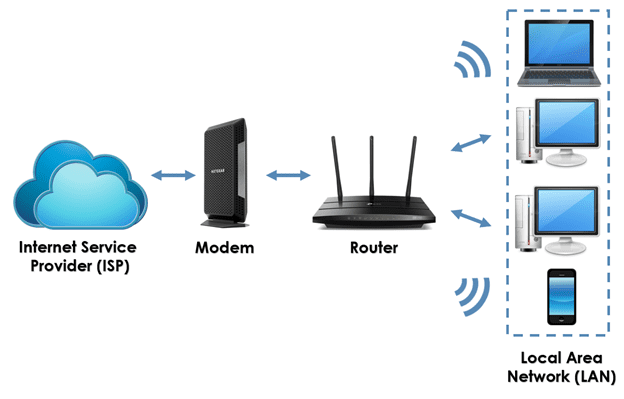
A router is a network device that allows multiple devices to communicate with each other over a network. About routers can accommodate multiple wired connections via Ethernet cables and wireless connections via WiFi. When yous connect a router to your modem, it sends data through radio signals to provide WiFi access to dozens of devices at once.
If you want to know more about the difference betwixt a router and a modem, bank check out our previous article here.
Many ISPs today provide subscribers with a modem and a router or a modem/router philharmonic device. While some ISPs require y'all to use the hardware they provide, about will let you utilize your own devices. If you tin utilise your own devices, having separate devices will give you more controls and features than a combo device.
Plus, with a separate modem and router, you tin supervene upon your router as engineering science improves. Since modem technology doesn't modify as rapidly every bit router applied science, beingness able to upgrade ane device at a fourth dimension makes things easier.
Should You lot Purchase Your Own Modem?
Buying your own modem can amend your internet connection and save you lot lots of money in the long run. The modem that your ISP rents to yous might be old, and you might exist paying much more in monthly fees than information technology's worth.
If you're going to purchase a DSL modem, yous might want to look for one that supports ADSL (asymmetric digital subscriber line) engineering science, which prioritizes download speeds over upload speeds. Also, await for a model that supports VDSL (very high-speed Digital Subscriber Line) technology, which tin significantly heave your internet speeds.
For cable internet, yous might want to expect for a modem that supports DOCSIS 3.1 technology, which supports download speeds upwards to 1 Gbps. If y'all're eager to future-proof though, you may want to consider ownership i that has DOCSIS 4.0 technology, which supports speeds upwards to 10 Gbps.
Since fiber optic engineering science is still relatively new, nigh ISPs will require you to install their ain Optical Network Terminals. While there are ways to purchase your own cobweb optic modem, they tin exist very expensive and difficult to install yourself.
If you're planning to phone call your Isp regarding buying your own modem, you should expect that they will strongly discourage you from doing so. Also, think that no thing how good your modem is, your internet will only be every bit fast as your plan. So, you will too have to upgrade your plan and your router if you want to get faster internet.
If you're looking for a new router, cheque out our list of the best WiFi routers of 2020 here.
do you need a modem and a router
Source: https://www.hellotech.com/blog/what-is-a-modem-what-does-it-do
